
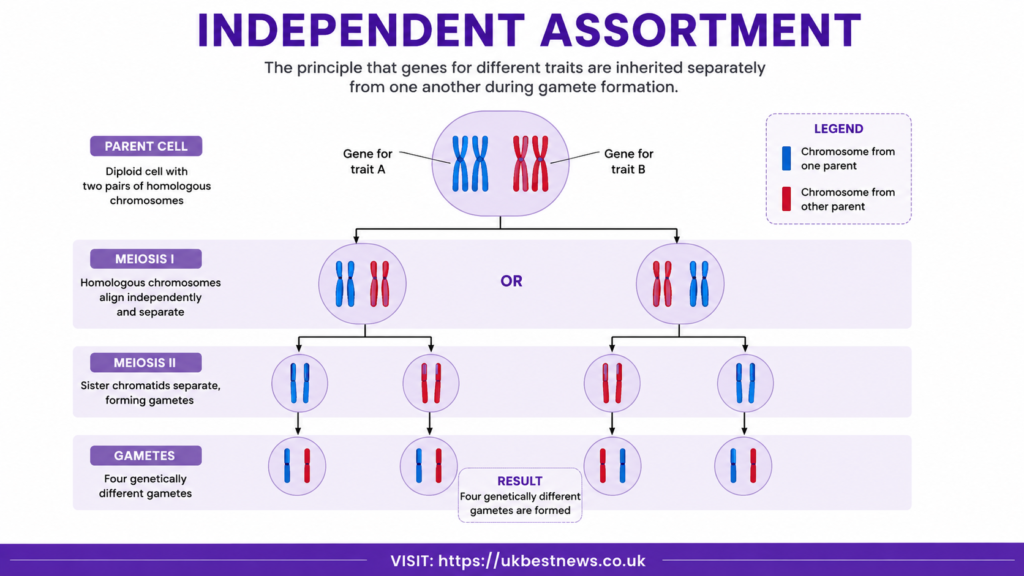

The concept of independent assortment stands as one of the most important principles in genetics, shaping how traits are inherited from one generation to the next. It explains how different genes are distributed into reproductive cells and ultimately passed on to offspring, contributing to the diversity we observe in living organisms. This principle is fundamental to understanding heredity, variation, and the complexity of genetic inheritance patterns in both simple and advanced organisms.
In modern biology, independent assortment is not just a theoretical idea but a practical framework used in genetics research, medicine, agriculture, and evolutionary biology. From predicting genetic traits in offspring to understanding inherited diseases, this concept plays a central role. By exploring independent assortment in detail, we can better appreciate how life maintains both continuity and diversity across generations.
The Origin and Discovery of Independent Assortment
The principle of independent assortment was first described by Gregor Mendel, often referred to as the father of genetics. Through his experiments with pea plants in the 19th century, Mendel observed how different traits were inherited independently of one another. His work laid the foundation for modern genetics, even though it was not widely recognized until decades later.
Mendel conducted cross-breeding experiments focusing on traits such as seed color and shape. He noticed that the inheritance of one trait did not influence the inheritance of another. This observation led to the formulation of the law of independent assortment, which states that alleles for different genes segregate independently during the formation of gametes. His discoveries revolutionized biological science and continue to influence genetic studies today.
Understanding the Basic Concept of Independent Assortment
Independent assortment refers to the process by which genes located on different chromosomes are distributed independently during the formation of gametes. This means that the inheritance of one gene does not affect the inheritance of another, provided the genes are not linked. It plays a critical role during meiosis, the process that produces sperm and egg cells.
During meiosis, homologous chromosomes are separated into different cells. Because each pair of chromosomes aligns independently of others, the resulting gametes contain a random mix of maternal and paternal chromosomes. This randomness ensures genetic variation, which is essential for evolution and adaptation in changing environments.
The Role of Chromosomes in Independent Assortment
Chromosomes serve as carriers of genetic information, and their behavior during cell division directly influences independent assortment. Each organism has a specific number of chromosomes, arranged in pairs. These pairs separate during meiosis, leading to different combinations of genes in gametes.
The key aspect of independent assortment lies in how these chromosome pairs line up during metaphase I of meiosis. Each pair aligns independently of others, meaning there are multiple possible orientations. This leads to a vast number of genetic combinations, even before considering other processes like crossing over. As a result, every gamete produced is genetically unique, contributing to the diversity of offspring.
Meiosis and Its Connection to Independent Assortment
Meiosis is a specialized type of cell division that produces haploid cells, which contain half the number of chromosomes as the parent cell. This process occurs in two stages, meiosis I and meiosis II, and is essential for sexual reproduction. Independent assortment primarily occurs during meiosis I.
In metaphase I, homologous chromosomes align at the center of the cell. The orientation of each pair is random, and this randomness determines how chromosomes are separated during anaphase I. As a result, each gamete receives a different combination of chromosomes. This mechanism ensures that offspring inherit a unique set of genetic traits from their parents.
Genetic Variation and Its Importance
One of the most significant outcomes of independent assortment is genetic variation. This variation is the foundation of evolution and natural selection. Without it, populations would lack the diversity needed to adapt to environmental changes, making them more vulnerable to extinction.
Genetic variation also plays a crucial role in human health and disease. Differences in genetic makeup can influence susceptibility to diseases, response to medications, and overall health outcomes. Independent assortment, along with other genetic processes, ensures that each individual has a unique genetic identity, even among siblings.
Differences Between Independent Assortment and Linked Genes
While independent assortment applies to genes located on different chromosomes, not all genes follow this principle. Some genes are located close together on the same chromosome and tend to be inherited together. These are known as linked genes, and they do not assort independently.
However, even linked genes can sometimes be separated through a process called crossing over, which occurs during meiosis. This exchange of genetic material between homologous chromosomes can create new combinations of genes. Understanding the difference between independent assortment and gene linkage is essential for accurately predicting inheritance patterns.
Real-Life Examples of Independent Assortment
Independent assortment can be observed in many real-life scenarios, particularly in traits inherited in humans and other organisms. For example, traits such as eye color and blood type are controlled by different genes located on separate chromosomes. As a result, they are inherited independently of one another.
In agriculture, independent assortment is used to breed plants with desirable traits. Farmers and scientists can combine traits such as disease resistance and high yield by selecting parent plants with specific genetic characteristics. This process relies heavily on the principles of independent assortment to achieve desired outcomes.
Applications in Modern Genetics and Biotechnology
The concept of independent assortment has numerous applications in modern science and technology. In genetic engineering, scientists manipulate genes to create organisms with specific traits. Understanding how genes assort independently helps in designing experiments and predicting outcomes.
In medicine, independent assortment is crucial for understanding genetic disorders and inheritance patterns. Genetic counseling often involves analyzing how certain traits or diseases are passed from parents to children. By applying this principle, healthcare professionals can provide better guidance and treatment options for patients and their families.
Independent Assortment in Evolutionary Biology
Independent assortment plays a vital role in evolution by promoting genetic diversity within populations. This diversity allows organisms to adapt to changing environments, increasing their chances of survival and reproduction. Over time, these adaptations can lead to the emergence of new species.
Natural selection acts on the variations created by independent assortment and other genetic processes. Traits that provide a survival advantage are more likely to be passed on to future generations. This continuous process drives the evolution of species and contributes to the complexity of life on Earth.
Common Misconceptions About Independent Assortment
Despite its importance, independent assortment is often misunderstood. One common misconception is that all genes assort independently. In reality, only genes located on different chromosomes or far apart on the same chromosome follow this principle.
Another misunderstanding is that independent assortment alone accounts for all genetic variation. While it is a major contributor, other processes such as mutation and crossing over also play significant roles. Recognizing these nuances is essential for a comprehensive understanding of genetics.
The Mathematical Perspective of Independent Assortment
Independent assortment can also be understood through probability and mathematical models. The likelihood of inheriting a particular combination of traits can be calculated using basic principles of probability. This approach is commonly used in genetics to predict the outcomes of crosses.
For example, if two traits are inherited independently, the probability of a specific combination is the product of the probabilities of each trait. This mathematical framework helps scientists and students analyze genetic data and understand inheritance patterns more clearly.
Independent Assortment in Human Genetics
In humans, independent assortment contributes to the wide range of physical and biological traits observed within populations. Characteristics such as height, skin color, and susceptibility to certain diseases are influenced by multiple genes that assort independently.
This principle also explains why siblings can have different combinations of traits, even though they share the same parents. Each child inherits a unique mix of genes due to the random nature of independent assortment during gamete formation.
The Role of Independent Assortment in Genetic Testing
Genetic testing has become increasingly important in modern healthcare, and independent assortment plays a key role in interpreting test results. By understanding how genes are inherited, scientists can identify patterns that indicate the presence of genetic disorders.
This knowledge is also used in prenatal testing and screening for inherited conditions. By analyzing genetic data, healthcare providers can assess the risk of certain diseases and provide appropriate recommendations for patients and their families.
Future Perspectives and Research Opportunities
The study of independent assortment continues to evolve as new technologies and research methods emerge. Advances in genomics and bioinformatics have made it possible to analyze genetic data on a large scale, providing deeper insights into inheritance patterns.
Future research may uncover new aspects of independent assortment and its role in complex genetic traits. These discoveries could lead to breakthroughs in medicine, agriculture, and biotechnology, further enhancing our understanding of life and its underlying mechanisms.
Conclusion
Independent assortment is a cornerstone of genetics, explaining how genes are distributed and inherited across generations. It plays a crucial role in creating genetic diversity, supporting evolution, and influencing countless aspects of biology and medicine. From Mendel’s pioneering experiments to modern genetic research, this principle has remained a fundamental concept in understanding life.
By exploring independent assortment in depth, we gain valuable insights into how traits are inherited and how variation arises within populations. Its applications in science and technology continue to expand, making it an essential topic for anyone interested in genetics and the study of living organisms.
FAQs
What is independent assortment in simple terms?
Independent assortment is the process by which genes for different traits are distributed separately during the formation of reproductive cells. This means that one trait does not influence the inheritance of another if the genes are on different chromosomes.
Why is independent assortment important?
It is important because it creates genetic variation, which is essential for evolution and adaptation. Without this variation, populations would struggle to survive in changing environments.
Does independent assortment apply to all genes?
No, it only applies to genes located on different chromosomes or far apart on the same chromosome. Genes that are close together tend to be inherited together and do not follow this principle.
How does independent assortment occur?
It occurs during meiosis, specifically in metaphase I, when homologous chromosomes align randomly. This random alignment leads to different combinations of genes in gametes.
What is the difference between independent assortment and segregation?
Segregation refers to the separation of alleles for a single gene, while independent assortment refers to the distribution of different genes independently of one another.
Can independent assortment be observed in humans?
Yes, it can be observed in the inheritance of traits such as eye color and blood type, which are controlled by genes on different chromosomes.
How does independent assortment contribute to evolution?
It contributes by increasing genetic diversity within populations. This diversity allows natural selection to act on different traits, leading to adaptation and the evolution of species.