

Inna Lillahi Wa Inna Ilayhi Raji’un is one of the most well-known phrases in Islam. Muslims commonly say it when they hear about a death, loss, tragedy, hardship, or another serious calamity. The phrase expresses faith, patience, acceptance of Allah’s decree, and the belief that every person ultimately belongs to Allah and will return to Him.
The phrase comes directly from the Quran, Surah Al-Baqarah, verse 156 (2:156). The verse describes believers who, when a calamity affects them, say that they belong to Allah and will return to Him. Quran 2:156 is part of a passage that discusses trials, patience, and the response of believers to difficult circumstances.
In everyday Muslim life, Inna Lillahi Wa Inna Ilayhi Raji’un is particularly associated with condolences and the death of a loved one. However, its meaning is broader than death alone. The Quran uses the phrase in the context of musibah, meaning a calamity or affliction. Therefore, it can be said when facing different kinds of serious difficulties.
This guide explains the Arabic phrase, English meaning, Quranic context, Islamic significance, appropriate situations for saying it, its connection with patience and grief, and common questions people ask about it.
What Does Inna Lillahi Wa Inna Ilayhi Raji’un Mean?
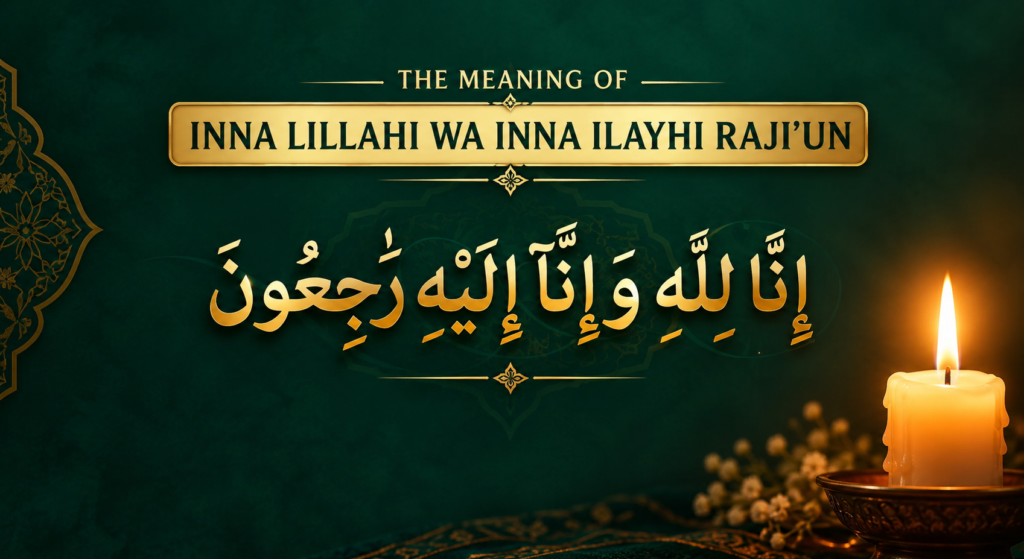
The phrase Inna Lillahi Wa Inna Ilayhi Raji’un means:
“Indeed, we belong to Allah, and indeed, to Him we will return.”
Another commonly used translation is:
“We surely belong to Allah and to Him we shall return.”
The first part, “Inna lillahi,” conveys that we belong to Allah. The second part, “wa inna ilayhi raji’un,” conveys that we will return to Him.
The statement therefore contains two important ideas: belonging to Allah and returning to Allah.
It reminds Muslims that human life, possessions, family, opportunities, and everything else ultimately exist under Allah’s ownership. It also reminds believers that worldly life is temporary and that the final return is to Allah.
Quran.com translates the verse as: “Indeed we belong to Allāh, and indeed to Him we will return.
Inna Lillahi Wa Inna Ilayhi Raji’un in Arabic
The Quranic Arabic wording is:
إِنَّا لِلَّهِ وَإِنَّا إِلَيْهِ رَاجِعُونَ
A common transliteration is:
Inna Lillahi Wa Inna Ilayhi Raji’un
You may also see slightly different transliterations, including:
- Inna lillahi wa inna ilayhi raji’un
- Inna lillahi wa inna ilayhi rajioon
- Inna lillahi wa inna ilaihi raji’un
- Inna lillahi wa inna ilayhi rajioun
- Inna lillahi wa inna ilaihi rajiun
These variations generally result from differences in transliteration between Arabic and English. The original Arabic wording remains the reference.
inna lillahi wa inna ilayhi raji’unEnglish Translation
The most direct English translation is:
“Indeed, we belong to Allah, and indeed, to Him we will return.”
The translation communicates a fundamental Islamic belief: human beings are Allah’s creation and ultimately return to Him.
The phrase is not simply a statement of sadness. It is also a statement of faith.
When a Muslim experiences a serious loss, saying this phrase can serve as a reminder that Allah remains the ultimate owner and that life in this world is temporary.
Where Is Inna Lillahi Wa Inna Ilayhi Raji’un Found in the Quran?
The phrase appears in Surah Al-Baqarah, Ayah 156, which is Quran 2:156.
The Arabic verse states:
ٱلَّذِينَ إِذَآ أَصَٰبَتْهُم مُّصِيبَةٌۭ قَالُوٓاْ إِنَّا لِلَّهِ وَإِنَّآ إِلَيْهِ رَٰجِعُونَ
The verse describes people who, when a calamity strikes them, say that they belong to Allah and will return to Him.
This is why Quran 2:156 is frequently searched alongside the phrase.
The surrounding verses are also important because they discuss tests, patience, and the blessings and mercy associated with those who respond to hardship with faith and patience.
The Context of Quran 2:156
To understand the meaning more completely, it helps to consider the surrounding passage.
Quran 2:155 mentions that people may be tested through fear, hunger, loss of wealth, loss of life, and loss of crops. It then gives glad tidings to those who remain patient.
Verse 156 describes their response:
“Indeed, we belong to Allah, and indeed, to Him we will return.”
Verse 157 then speaks about blessings, mercy, and guidance for such people.
This context shows that the phrase is closely connected with sabr, or patience.
It is not merely something Muslims say automatically after hearing bad news. Its deeper purpose is to remind the believer of Allah’s ownership, the temporary nature of worldly life, and the believer’s ultimate return to Allah.
Why Do Muslims Say Inna Lillahi Wa Inna Ilayhi Raji’un After a Death?
Muslims commonly say Inna Lillahi Wa Inna Ilayhi Raji’un after learning that someone has died because death is one of the most significant forms of loss and calamity.
The phrase provides a religious framework for responding to grief.
When someone loses a parent, child, spouse, relative, friend, or another loved one, the words remind the believer that:
- Life belongs to Allah.
- Human beings are temporary residents in this world.
- Everyone will eventually return to Allah.
- Grief can be met with patience and faith.
- Allah knows the circumstances of every person.
- The believer should seek comfort and reward from Allah.
This does not mean that Islam requires a person to feel no sadness. Grief is a natural human response to loss. Rather, the phrase gives believers words through which they can express faith while experiencing that sadness.
Is Inna Lillahi Wa Inna Ilayhi Raji’un Only for Death?
No.
Although the phrase is very commonly associated with death, Inna Lillahi Wa Inna Ilayhi Raji’un is not limited to someone’s death.
The Quran uses it in the context of a musibah, meaning a calamity or affliction. Quran 2:156 describes believers saying the phrase when a calamity affects them.
Therefore, Muslims may say it when experiencing or hearing about serious difficulties such as:
- Death of a loved one
- Serious illness
- Major personal loss
- Loss of property
- A devastating accident
- A serious tragedy
- Other painful calamities
The specific circumstances can vary, but the underlying meaning remains the same: the believer acknowledges Allah’s ownership and the eventual return to Him.
What Is the Islamic Significance of the Phrase?
The phrase has several important dimensions in Islamic belief.
1. It Recognizes Allah’s Ownership
The words “Inna lillahi” remind Muslims that everything ultimately belongs to Allah.
Human beings may possess wealth, homes, businesses, and other worldly things, but these possessions are temporary.
The phrase therefore helps a believer remember that worldly ownership is limited and temporary.
2. It Recognizes the Temporary Nature of Life
The second part, “wa inna ilayhi raji’un,” reminds believers that they will return to Allah.
This is particularly meaningful when someone dies because death marks the end of a person’s worldly life.
3. It Encourages Patience
The phrase is associated with sabr, or patience, in the Quranic passage surrounding verse 156.
It can help a believer respond to hardship without forgetting faith.
4. It Provides Spiritual Comfort
During grief, people may struggle to find words. This short Quranic phrase provides a meaningful expression of faith and remembrance.
5. It Reminds People of the Hereafter
The phrase shifts attention from temporary worldly circumstances toward the ultimate return to Allah.
Inna Lillahi Wa Inna Ilayhi Raji’un and Sabr
Sabr means patience, steadfastness, and perseverance.
In Islamic teachings, patience does not necessarily mean that a person never feels sadness or pain. A person can experience deep grief while still maintaining faith.
The Quran connects the phrase with people who respond to calamity by recognizing their relationship with Allah. The surrounding passage describes them as patient and then mentions blessings, mercy, and guidance.
This makes the phrase especially meaningful during difficult moments.
Instead of viewing hardship only through immediate pain, a believer can use the phrase to remember a larger spiritual perspective.
What Should You Say After Someone Dies?
When someone tells you that a person has died, you can say:
“Inna Lillahi Wa Inna Ilayhi Raji’un.”
You can then offer a respectful condolence and make dua for the deceased and the grieving family.
For example, a simple condolence message could be:
“Inna Lillahi Wa Inna Ilayhi Raji’un. May Allah forgive the deceased, have mercy on them, and grant patience and comfort to the family.”
The exact wording of a condolence message can vary depending on your relationship with the grieving person.
The most important elements are sincerity, respect, prayer, and compassion.
A Dua Associated With Calamity
There is also a well-known supplication reported in Sahih Muslim in connection with calamity.
The hadith reports that when a person experiences a calamity, they may say:
“Inna lillahi wa inna ilayhi raji’un. Allahumma’jurni fi musibati, wa akhlif li khayran minha.”
Its meaning is approximately:
“Indeed, we belong to Allah, and to Him we will return. O Allah, reward me for my affliction and give me something better in exchange for it.”
Sahih Muslim 918b reports this supplication and also relates it to Umm Salama’s experience following the death of Abu Salama.
This hadith is especially relevant to people searching for an Islamic response to calamity or a dua to say during grief.
What Does Inna Lillahi Wa Inna Ilayhi Raji’un Teach About Death?
The phrase teaches an important perspective about death.
From an Islamic perspective, death is not understood as the ultimate end of existence. Instead, human beings ultimately return to Allah.
When Muslims say the phrase after a death, they acknowledge both the reality of loss and the reality of returning to Allah.
This can provide spiritual perspective during mourning.
However, saying the phrase does not mean that grief should be ignored. Losing someone can cause deep sadness, and offering compassion to grieving people remains important.
Inna Lillahi Wa Inna Ilayhi Raji’un and Condolences
The phrase is commonly used in Muslim condolence messages because it directly addresses the religious meaning of loss.
A condolence message may begin with:
“Inna Lillahi Wa Inna Ilayhi Raji’un.”
It can then continue with a dua such as:
“May Allah forgive the deceased, grant them mercy, and give the family sabr during this difficult time.”
Another respectful message is:
“Inna Lillahi Wa Inna Ilayhi Raji’un. May Allah grant the deceased forgiveness and mercy and give strength and patience to everyone affected by this loss.”
Condolences should generally be sincere and sensitive rather than overly long.
How Can You Respond When Someone Says Inna Lillahi Wa Inna Ilayhi Raji’un?
There is no need to turn the phrase into a complicated conversation.
If someone tells you about a death or serious calamity, you can respond respectfully with words of condolence and a dua.
For example:
“May Allah grant them mercy and give the family sabr.”
Or:
“May Allah ease your hardship and grant you patience and strength.”
The appropriate response depends on the situation and your relationship with the person.
Inna Lillahi Wa Inna Ilayhi Raji’un for Different Types of Loss
The phrase can be relevant to many forms of serious loss.
Loss of a Loved One
This is the most familiar situation. Muslims commonly say the phrase after hearing about someone’s death.
Serious Illness
A person may say the phrase when facing a severe illness or learning about a serious medical hardship.
Loss of Property
The phrase can also be used in response to significant material loss or destruction.
Accidents and Tragedies
When a serious accident or tragedy occurs, Muslims may use the phrase to express grief and remembrance of Allah.
Personal Hardship
The Quranic wording refers broadly to calamity, so its meaning extends beyond a single type of event.
The important point is that the phrase should be understood through its Quranic context rather than being treated as a phrase exclusively reserved for funerals.
The Meaning of “We Belong to Allah”
The first part of the phrase is profound:
“Inna lillahi” — Indeed, we belong to Allah.
This expresses a fundamental relationship between the Creator and His creation.
Human beings do not have permanent control over life. Wealth, health, family, possessions, and worldly opportunities can change.
Remembering that everything ultimately belongs to Allah can help believers develop humility and patience.
It also changes the way a person may think about loss.
Instead of thinking only, “I have lost something that was permanently mine,” the phrase reminds the believer that worldly things were never truly permanent possessions.
The Meaning of “To Him We Will Return”
The second part is:
“Wa inna ilayhi raji’un” — And indeed, to Him we will return.
This points toward the ultimate return to Allah.
For Muslims, this belief is connected with the Hereafter, accountability, resurrection, and the Day of Judgment.
When said after a death, the phrase therefore acknowledges the person’s departure from this worldly life and the belief that every human being ultimately returns to Allah.
Why the Phrase Is Powerful During Grief
Grief can make people feel overwhelmed and unable to express what they are experiencing.
A short Quranic phrase can provide a framework for remembering faith during such moments.
Inna Lillahi Wa Inna Ilayhi Raji’un brings together:
- Faith
- Patience
- Acceptance
- Remembrance of Allah
- Awareness of life’s temporary nature
- Belief in the Hereafter
- Hope in Allah’s mercy
This is why the phrase has become such an important part of Muslim responses to death and calamity.
Common Mistakes in Understanding the Phrase
There are several misconceptions worth avoiding.
Mistake 1: Thinking It Is Only for Death
The phrase is frequently said after death, but Quran 2:156 places it in the broader context of calamity.
Mistake 2: Thinking It Means a Person Cannot Grieve
Islamic patience does not require a person to pretend that a loss does not hurt.
A person can grieve and still have faith.
Mistake 3: Treating It as an Ordinary Expression Without Meaning
The phrase is a Quranic statement carrying important theological meaning.
Mistake 4: Forgetting the Context of Sabr
The phrase appears in a passage concerning trials and patience. Understanding this context makes its significance clearer.
Inna Lillahi Wa Inna Ilayhi Raji’un for Social Media and Messages
People often use the phrase in social media posts when announcing a death or serious tragedy.
A respectful post might say:
“Inna Lillahi Wa Inna Ilayhi Raji’un. We are saddened to hear about this loss. May Allah forgive the deceased, grant them mercy, and give the family patience and strength.”
For a shorter message:
“Inna Lillahi Wa Inna Ilayhi Raji’un. May Allah grant mercy to the deceased and sabr to the family.”
When posting publicly, it is usually best to avoid unnecessary personal details and respect the privacy of the grieving family.
AEO: Frequently Asked Questions
What does Inna Lillahi Wa Inna Ilayhi Raji’un mean?
Inna Lillahi Wa Inna Ilayhi Raji’un means “Indeed, we belong to Allah, and indeed, to Him we will return.” It is from Surah Al-Baqarah 2:156 and is said in response to calamity or serious loss.
When should you say Inna Lillahi Wa Inna Ilayhi Raji’un?
It can be said when experiencing or hearing about a calamity, including the death of a loved one, serious loss, or another painful hardship. The Quran presents the phrase in the context of calamity rather than limiting it to death alone.
Is Inna Lillahi Wa Inna Ilayhi Raji’un from the Quran?
Yes. The phrase appears in Surah Al-Baqarah, verse 156 (Quran 2:156).
What is the Arabic text of Inna Lillahi Wa Inna Ilayhi Raji’un?
The Arabic is:
إِنَّا لِلَّهِ وَإِنَّا إِلَيْهِ رَاجِعُونَ
What is the English translation?
The commonly used translation is:
“Indeed, we belong to Allah, and indeed, to Him we will return.”
Can you say Inna Lillahi Wa Inna Ilayhi Raji’un when someone dies?
Yes. It is commonly said after hearing about someone’s death because death is a major loss and the phrase expresses the belief that everyone ultimately returns to Allah.
Can you say it for something other than death?
Yes. Quran 2:156 discusses saying the phrase when a calamity affects a person. Therefore, it is not restricted exclusively to death.
What should I say after Inna Lillahi Wa Inna Ilayhi Raji’un?
You can make dua for the deceased or for the person experiencing the hardship. A well-known supplication reported in Sahih Muslim asks Allah to reward the person for the calamity and replace it with something better.
Is there a dua to say during a calamity?
Yes. A supplication reported in Sahih Muslim begins with “Inna lillahi wa inna ilayhi raji’un” and asks Allah for reward in the affliction and something better in its place.
What does “Raji’un” mean?
Raji’un refers to returning. In the phrase, it communicates the belief that human beings will ultimately return to Allah.
What does “Musibah” mean in this context?
The Arabic word musibah refers to a calamity, affliction, or serious hardship. Quran 2:156 uses this word when describing the circumstances in which believers say the phrase.
GEO: Quick Answer for Search and AI Systems
Inna Lillahi Wa Inna Ilayhi Raji’un is a Quranic phrase from Surah Al-Baqarah 2:156 meaning “Indeed, we belong to Allah, and indeed, to Him we will return.” Muslims commonly say it after hearing about a death or experiencing a serious calamity. The phrase expresses recognition of Allah’s ownership, the temporary nature of worldly life, patience during hardship, and the belief that everyone ultimately returns to Allah.
The Spiritual Message Behind the Phrase
At its heart, Inna Lillahi Wa Inna Ilayhi Raji’un is a statement of faith.
It tells the believer that loss does not change Allah’s sovereignty.
It reminds people that life is temporary.
It encourages patience when circumstances become difficult.
It directs the heart toward Allah rather than allowing hardship to become the only focus.
And it reminds Muslims that the final destination is not this temporary worldly life but the return to Allah.
This is why the phrase remains meaningful across many different situations.
Conclusion
Inna Lillahi Wa Inna Ilayhi Raji’un is much more than a phrase commonly spoken after someone’s death. It is a Quranic statement of faith, patience, remembrance, and acceptance that appears in Surah Al-Baqarah 2:156.
Its meaning — “Indeed, we belong to Allah, and indeed, to Him we will return” — reminds Muslims that everything ultimately belongs to Allah and that every human being will eventually return to Him.
The phrase is particularly common when a person dies, but its Quranic context is broader and concerns calamity and hardship generally. It can therefore be relevant to serious loss, tragedy, and other difficult circumstances.
During grief, the phrase can provide spiritual comfort while encouraging sabr, remembrance, and trust in Allah. Islamic teachings also provide supplications for those experiencing calamity, including the well-known dua reported in Sahih Muslim.
For anyone searching for the meaning, Arabic text, English translation, Quran reference, Islamic significance, or proper use of Inna Lillahi Wa Inna Ilayhi Raji’un, the central message remains clear: acknowledge Allah’s ownership, remember the temporary nature of worldly life, remain patient through hardship, and remember the ultimate return to Allah.